
The Next Frontier of Bespoke Advisory: Navigating Multi-Asset Portfolios and Sovereign Mobility for UHNWIs
An authoritative analysis of how shifting cross-border regulations, global mobility mandates, and high-value tangible assets are redefining strategic advisory standards for modern family offices and luxury executives.

In an era defined by macro-financial volatility, shifting regulatory boundaries, and unprecedented intergenerational wealth succession, the conventional delineation between classic private banking and luxury asset advisory has ceased to be functionally viable. Ultra-high-net-worth individuals (UHNWIs) and single-family offices increasingly view their capital allocations not through isolated balance sheets of equities and sovereign debt, but through an integrated, borderless tapestry of lifestyle holdings, tangible passion assets, and philanthropic vehicles. For the modern private wealth practitioner, executive advisor, or luxury entrepreneur, generic domain expertise no longer provides a defensible competitive moat. Navigating this multi-trillion-euro structural realignment demands cross-disciplinary literacy across marine infrastructure, haute horlogerie, blue-chip visual art, cross-border property portfolios, and sovereign regulatory compliance.
Historically, the advisory ecosystem operated within rigid silos. Private bankers managed liquid securities; maritime brokers orchestrated superyacht charters; gallerists stewarded acquisitions in Basel or London; and boutique aviators negotiated fractional airframes. Today, that fragmented model has collapsed under the weight of fiscal scrutiny, tax transparency, and rising asset complexity. Discerning principals now demand trusted advisors who possess not only sophisticated capital-markets acumen, but also an intimate understanding of maritime salvage law, provenance verification protocols, and bespoke operational governance. To understand how modern luxury advisory has transformed into an institutional discipline, one must examine the intersection of balance-sheet strategy and passion-asset custody.
The Institutionalisation of Alternative and Passion Assets
Alternative passion assets have definitively transitioned from discretionary prestige symbols to strategically managed, cross-collateralised store-of-value instruments. Whether deployed to hedge against sovereign currency depreciation, to establish fiscal domicile, or to express cultural stewardship, these physical holdings demand precise stewardship throughout their lifecycles. Institutional-grade valuation methodologies, once reserved for corporate balance sheets, are routinely applied to rare timepieces, contemporary masterpieces, and bespoke aviation assets.
Family offices and private banks have expanded their risk models to account for the unique liquidity horizons, holding costs, and insurance parameters intrinsic to these tangible investments. An elite client holding an estate in Cap d’Ail, a 65-metre displacement yacht registered under the Red Ensign, and an extensive inventory of post-war European canvases requires holistic risk orchestration. As documented in our review of strategic shifts in wealth governance, single-family offices are progressively prioritising multi-jurisdictional transparency, professionalising their teams with executives who can bridge the divide between capital preservation and physical asset optimisation.
This macro-trend has profoundly elevated the standard of professional preparation across the industry. Advisors who navigate complex multi-asset portfolios must systematically master both fiscal engineering and connoisseurship. Aspiring professionals seeking institutional-grade instruction in these intersecting fields frequently turn to specialized qualifications such as the Wealth & Investment Management Course, which contextualises portfolio theory against the nuanced backdrop of global luxury markets and high-value tangible assets.
Maritime Capital: Superyacht Governance and Marine Asset Strategy
Nowhere is the intersection of high finance, engineering complexity, and international maritime law more pronounced than in the global superyacht sector. Far from being passive leisure platforms, modern gigayachts are complex sovereign assets operating across multiple maritime jurisdictions, employing multinational crews, and subject to increasingly stringent environmental mandates. Environmental, Social, and Governance (ESG) directives, such as the International Maritime Organization’s carbon intensity regulations, have made eco-efficiency, hybrid propulsion, and green lifecycle tracking decisive variables in asset depreciation and resale liquidity.
The operational management of these vessels entails maritime labour conventions (MLC 2006), flag-state registrations, customs importations via temporary admission frameworks, and complex charter VAT fiscal regimes. A failure in operational or legal compliance can instantly trigger multi-million-euro penalties, arrest warrants in international ports, or catastrophic insurance coverage voids. Consequently, brokerage and yacht management have emerged as rigorous legal and technical disciplines that demand comprehensive operational fluency.
Those who structure maritime acquisitions or guide families through complex build contracts cannot rely purely on interpersonal charm. The contemporary broker must master salvage liabilities, technical surveying, charter yield forecasting, and contractual dispute resolution under standard MYBA or Mediterranean contractual frameworks. Forward-thinking executives hone these precise proficiencies through the accredited Yacht Brokerage Course, which imparts the legal acumen, negotiation frameworks, and operational strategies necessary to represent discerning maritime clients at the highest tier.
Beyond transactions, the continuous lifecycle stewardship of mega-vessels demands elite operational directors. Crew retention, shipyard refit oversight, statutory flag surveys, and safety management systems (SMS) require specialized maritime administration. The industry has witnessed an influx of career professionals completing the Luxury Yacht Manager Course, equipping them to interface authoritatively between family office principals, classification societies, and marine naval architects.
Aviation Infrastructure and Cross-Border Mobility
Parallel to the maritime sector, private aviation has undergone profound structural modernisation. The private jet is no longer merely a conduit for unencumbered travel; it represents a critical tool of commercial statecraft, executive productivity, and secure international transit. However, navigating the private aviation space requires meticulous technical comprehension of Aircraft Operating Certificates (AOC), Part 135 charter structures, Cape Town Convention registry rights, and evolving emissions trading schemes (ETS).
When structuring an aircraft acquisition, an advisor must weigh the operational benefits of full ownership against fractional programmes, jet cards, and structured dry-lease alternatives. Depreciation schedules, maintenance reserve provisioning (such as engine maintenance programmes like Rolls-Royce CorporateCare or Pratt & Whitney ESP), and residual value preservation require forensic financial modelling. The logistical friction of international airspace corridors, slot allocations at congested hub airports like Nice Côte d'Azur or Geneva, and crew duty limitations demand world-class logistical expertise.
Professionals tasked with overseeing private jet operations must possess comprehensive fluency in safety management protocols, ground handling logistics, and operational economics. This operational mastery is systematically cultivated through the Private Jet Fleet Manager Course, which prepares executives to run corporate flight departments and family aviation assets with peerless precision. Similarly, transaction professionals who negotiate multi-million-euro transactions between sovereign principals, financiers, and OEMs refine their transactional agility via the accredited Aircraft Brokerage Course.
Connoisseurship as a Financial Discipline: Art and Haute Horlogerie
The maturation of art and rare horology into recognized alternative asset classes has introduced unprecedented demand for transparency, provenance verification, and connoisseurship. Independent valuation boards and family office committees now examine cultural holdings with the same procedural diligence applied to direct private equity placements. In an era characterised by secondary-market price volatility and intensified anti-money laundering (AML) directives, subjective aesthetic appreciation must be underpinned by objective valuation frameworks.
The Fine Art Ecosystem: Due Diligence, Provenance, and Freeports
Blue-chip fine art represents an exceptional asset class: it yields no dividends, carries substantial custody and conservation liabilities, yet consistently displays low correlation to broader public equity indices. Managing a multi-million-euro art collection requires rigorous adherence to title insurance standards, copyright licenses, export restrictions (such as national treasure categorisations under French or Italian cultural patrimony codes), and tax-advantaged storage in licensed freeports like Geneva, Luxembourg, or Singapore.
Advisors must navigate the complex dynamics of auction-house guarantees, private-treaty consignments, and museum loans, all while safeguarding client anonymity and compliance. To operate effectively within this opaque global market, professionals require structured instruction that combines historical connoisseurship with transactional mastery. The Luxury Art Dealership Course provides this precise institutional foundation, instructing candidates on condition reporting, secondary-market price indexing, art financing mechanisms, and rigorous authentication procedures.
Haute Horlogerie: Micro-Mechanics, Rarity, and Secondary-Market Dynamics
Simultaneously, the secondary market for rare, collectible timepieces has transitioned from a niche collector community into a global, institutionalised trading sphere. Complicated vintage references from independent watchmakers such as Philippe Dufour, F.P. Journe, and Kari Voutilainen, alongside historically pivotal pieces from Patek Philippe and Audemars Piguet, command valuations that rival prime real estate. The analytical assessment of a timepiece requires granular verification: assessing case oxidation, unpolished bevels, movement component authenticity, serial records, and archival extract validation.
The professional horology dealer or wealth manager must also evaluate production volume scarcity, cultural provenance, and movement architecture. As financial houses explore watch-backed asset securitisation and fractional investment funds, the demand for certified specialists has expanded rapidly. Professionals navigating this high-margin vertical consolidate their technical knowledge and commercial acumen through the Luxury Watch Dealership Course, bridging the gap between mechanical mastery and modern secondary-market enterprise.
The Family Office Convergence: Orchestrating Interdisciplinary Capital
The convergence of these distinct physical and financial domains inevitably takes place within the modern family office. Single- and multi-family offices (SFOs and MFOs) now serve as the nerve centers for the world’s most influential lineages. The contemporary Family Office Executive must operate as a grand strategist: coordinating wealth structuring, legacy planning, next-generation governance, tax mitigation, cybersecurity, and physical asset stewardship within an integrated operational matrix.
A classic structural failure in wealth preservation occurs when passion assets are treated as independent lifestyle expenses rather than strategic components of a family’s broader balance sheet. High-value property portfolios in prime jurisdictions, such as the Principality of Monaco, London, or New York, must be harmonised with international mobility strategies, succession tax shelters, and corporate holding schemes. Consider the multidimensional expertise required to structure an integrated family holdings model:
- Sovereign Fiscal Structuring: Harmonising residency status, dual citizenship frameworks, and tax liabilities across varied European, American, and Asian tax jurisdictions.
- Asset Protection and Custody: Implementing trusts, foundations, and special purpose vehicles (SPVs) that protect marine vessels, aircraft, and art collections from litigious exposure and political volatility.
- Operational Risk and Cybersecurity: Mitigating digital vulnerabilities, safeguarding personal tracking signatures on marine and aviation assets, and enforcing strict non-disclosure compliance across domestic and operational staff.
- Succession and Philanthropic Governance: Preparing Next-Gen principals to steward complex, multi-generational family enterprises while maintaining strategic alignment with family values and international philanthropic initiatives.
Because the modern family office sits at the nexus of these competing disciplines, executives leading these institutions require an unprecedented breadth of executive leadership. The Family Office Management Course has become an international benchmark for leaders tasked with architecting, scaling, and safeguarding the comprehensive affairs of ultra-wealthy dynasties.
The Essential Competencies of the Modern Luxury Asset Broker
As the boundaries separating private aviation, superyachting, fine art, and prime residential property continue to dissolve, a new category of elite intermediary has emerged: the cross-asset luxury broker. Historically, a real estate broker rarely understood the intricacies of aircraft maintenance logs, and an art advisor had little insight into maritime flag registrations. Today, elite clients expect a unified advisory experience. A trusted advisor who commands the respect of a principal must be equipped to advise across their entire portfolio of passion assets with consistent institutional authority.
To succeed at this pinnacle of advisory practice, top-tier professionals must cultivate five indispensable competencies:
- Cross-Market Due Diligence: The capacity to execute forensic legal, physical, and financial auditing across disparate physical assets, from prime real estate titles to aircraft airframe logs.
- Negotiation Under Extreme Asymmetry: Managing complex, multi-party transactions where geopolitical sensitivities, ultra-high financial stakes, and asymmetric market data intersect.
- Global Regulatory and Fiscal Literacy: Anticipating the downstream tax, duty, and registration ramifications of cross-border asset transfers across key regulatory corridors.
- Connoisseurship and Qualitative Valuation: Blending rigorous quantitative discounted cash-flow or comparative market analysis with an intuitive grasp of provenance, rarity, and cultural prestige.
- Bespoke Relationship Architecture: Establishing unassailable trust with principals, gatekeepers, family office counsels, and private bankers through discretion, emotional intelligence, and relentless operational excellence.
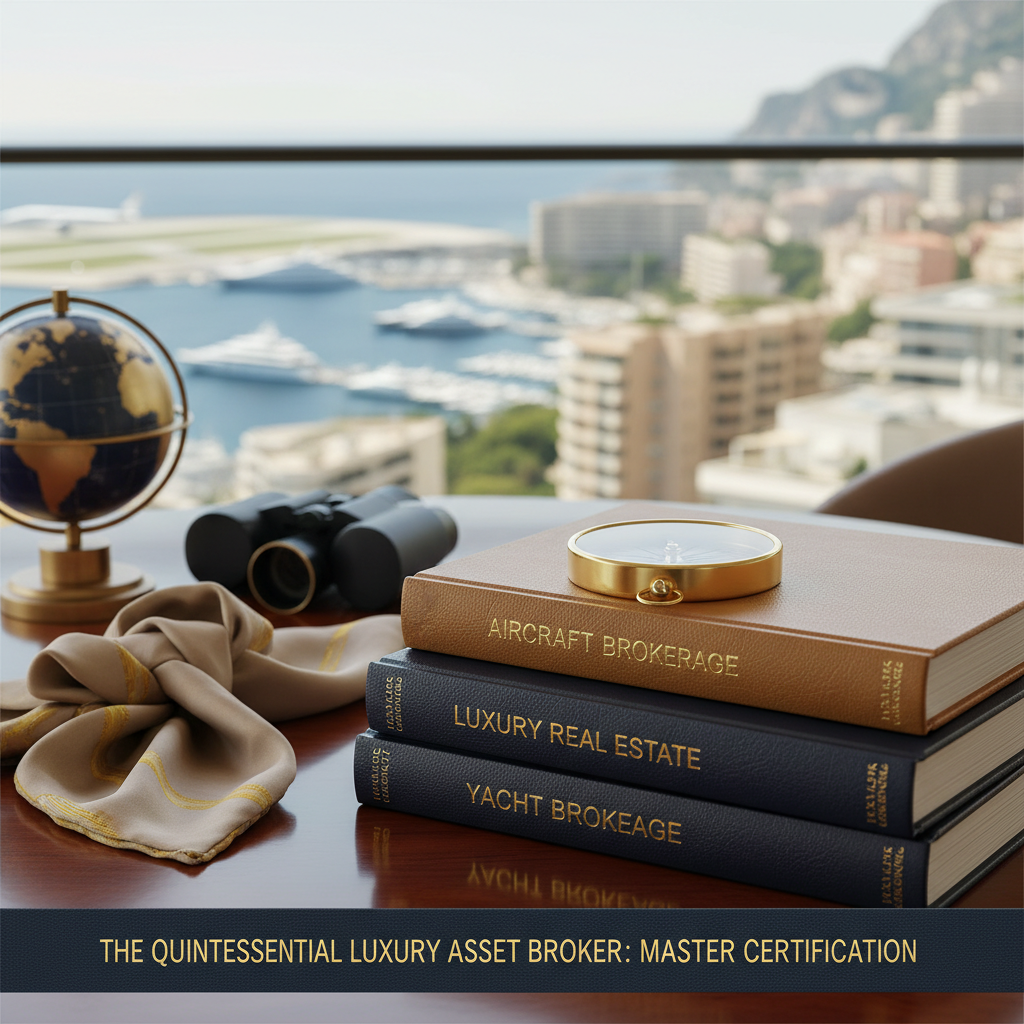
Recognising that few professionals natively possess this multi-dimensional fluency, Monaco Academy developed the comprehensive The Quintessential Luxury Asset Broker: Master Certification. This elite master program synthesises high-stakes yacht brokerage, aircraft sales, prime residential real estate, and blue-chip art into an integrated, prestigious professional credential designed for top-tier advisors.
Why Monaco Remains the Epicentre of Luxury Capital and Advisory Innovation
The strategic shifts reshaping luxury asset advisory are felt globally, yet their intellectual and commercial epicenter remains firmly rooted in the Principality of Monaco. Positioned on the Mediterranean coastline, Monaco offers more than safety, tax efficiency, and an exceptional climate; it represents the dense concentration of global capital, maritime innovation, and ultra-high-net-worth leadership on earth. Discovering why Monaco commands this unmatched reputation reveals how its geographical and regulatory ecosystem fosters advisory excellence.
From the superyachts moored in Port Hercule to the private banking institutions lining Boulevard des Moulins, Monaco serves as a real-time laboratory for cross-asset wealth management. The Principality regularly leads international discourse on sustainable ocean preservation, green yachting design, sovereign wealth governance, and alternative luxury asset finance. Here, transactions are not theoretical exercises conducted in abstract digital marketplaces; they are negotiated face-to-face between global decision-makers, family principals, and their closest advisors.
For professionals aspiring to lead in the luxury economy, grounding their education within Monaco’s distinctive business milieu offers an unparalleled strategic advantage. The demands placed upon executives in the Principality reflect the highest standards anywhere in the world. To thrive in this environment, one must combine the discretion of an elite diplomat with the operational discipline of an institutional investment director.
Modern Executive Upskilling: Mastering the Digital Atelier
Given the rigorous operational demands faced by active wealth advisors, family office directors, and luxury entrepreneurs, traditional full-time executive education is frequently incompatible with professional schedules. Today’s leaders cannot easily step away from cross-border deal flow, ongoing client mandates, and multi-jurisdictional travel to attend campus-bound academic programmes. Consequently, executive upskilling within the luxury sphere has undergone a sophisticated digital transformation.
Modern luxury leaders demand flexible, high-yield learning frameworks that deliver rigorous academic depth without sacrificing operational commitments. As detailed in our analysis of mastering asynchronous executive education for luxury leaders, digital curricula engineered specifically for high-calibre professionals provide immediate, real-world utility. Interactive case studies, forensic legal analyses, and actionable financial templates enable executives to absorb specialised industry intelligence asynchronously and apply it instantly across their professional practices.
Whether navigating complex international maritime charters, conducting due diligence on rare timepieces, or advising a private banking client on collateralised art financing, access to modular, elite-level pedagogy is now a critical tool for continuous career ascension. The digital atelier model synthesises the intellectual authority of a European business school with the agile responsiveness demanded by modern private wealth practice.
The Sovereign Advisory Imperative: Elevating Client Trust in a Fragmented World
The luxury landscape is navigating a profound transformation. The traditional markers of status—ostentation, conspicuous consumption, and fragmented transactional advisory—are yielding to an era defined by discretion, operational precision, environmental consciousness, and integrated cross-asset literacy. Today’s ultra-wealthy principals do not require more vendors; they require trusted sovereign advisors capable of orchestrating their balance sheets, assets, and dynastic legacies with clarity and integrity.
Professionals who rise to meet this mandate will define the future of private wealth advisory, luxury brokerage, and family office stewardship. By mastering the multifaceted nuances of maritime law, aviation infrastructure, fine art provenance, haute horlogerie, and wealth structuring, advisors transform themselves from transactional service providers into indispensable strategic partners. In the ultimate analysis, the currency of the elite luxury economy is not merely capital—it is unshakeable, verified competence.
Tagged
Written by
Monaco Academy Editorial
Editorial Team
Put this into practice
Courses and programs on this subject

Family Office Management Course
Become a Certified Family Office Manager leading ultra-high-net-worth families with bespoke financial, legal, and lifestyle solutions.

Wealth & Investment Management Course
Become a Certified Wealth & Investment Manager, mastering advanced strategies to navigate global financial markets and serve discerning clientele.

Luxury Brand Management Course
Become a Certified Luxury Brand Manager, mastering the art and science of building and sustaining prestigious brands in a competitive global market.
Related programs
Continue reading
Related articles
17 October 2026 · 11 min
Monaco Academy Unveils Advanced Certification: Navigating the Evolving Landscape of Sustainable Luxury Finance
Monaco Academy announces a new advanced certification designed for luxury professionals and HNWI advisors. This program offers deep insights into sustainable investment strategies, green finance principles, and impact investing within the luxury sector, aligning with Monaco's leadership in ethical wealth management and environmental stewardship.

10 October 2026 · 12 min
Monaco Academy Insights: Navigating the Future of Luxury Leadership in a Dynamic World – A Trend Analysis with Concrete Examples
Explore the cutting-edge trends shaping the luxury sector and discover how visionary leaders are adapting to a rapidly evolving global landscape. This Monaco Academy exclusive offers a deep dive into strategic innovations, sustainability imperatives, and the digital transformation driving success for professionals and HNWI service providers.

07 October 2026 · 11 min
Navigating the New Luxury Frontier: Strategic Imperatives from Monaco Academy's Latest Insights
Explore Monaco Academy's cutting-edge insights on the evolving luxury landscape. This deep-dive explainer dissects key trends, from sustainable luxury to the impact of digital transformation, offering ambitious professionals, entrepreneurs, and HNWI service providers practical strategies to thrive in a dynamic, discerning market.