
Monaco Academy News and Insights — fresh perspective from the past 30 days
Over the past thirty days, global wealth advisory circles, maritime asset directors, and family office principals have converged on a singular realisation: the paradigms defining modern ultra-high-net-worth individual (UHNWI) engagement are transforming at…

Over the past thirty days, global wealth advisory circles, maritime asset directors, and family office principals have converged on a singular realisation: the paradigms defining modern ultra-high-net-worth individual (UHNWI) engagement are transforming at unprecedented velocity. Through the lens of Monaco Academy News and Insights, the recent month has laid bare an unmistakable pivot towards operational transparency, rigorous regulatory compliance, and cross-disciplinary asset management within the luxury ecosystem. From the sunlit harbours of Port Hercule to the boardrooms of private wealth hubs, commercial intuition is no longer sufficient on its own; sustainable success requires an institutional framework backed by certified professional expertise.
The Principality of Monaco continues to function as the intellectual and commercial epicenter of this evolution. As volatile macroeconomic indicators challenge traditional capital deployment, the demand for sophisticated, specialized competence has never been more pronounced. Observers examining the developments of the previous month recognise that the modern luxury landscape is neither purely emotional nor entirely algorithmic; it is an intricate nexus of cross-border jurisprudence, sustainable stewardship, and emotional intelligence. To understand how discerning practitioners are mastering these dynamics, one must examine the specific systemic shifts recorded over the last month across family governance, private maritime stewardship, luxury brand value preservation, and multi-asset brokering.
The Great Wealth Migration: Governance Shifts Across Family Offices
The past 30 days have underscored an accelerating transition in generational wealth governance. Family offices operating out of Europe, the Middle East, and North America are actively re-evaluating their organizational design, moving away from fragmented advisory councils towards integrated executive command structures. As patriarchs and matriarchs systematically hand executive control to Millennial and Generation Z heirs, the operational ethos has shifted from passive asset preservation to active values-based stewardship. Monaco has mirrored this transformation, serving as a global testbed for novel governance frameworks that balance jurisdictional agility with fiscal responsibility.
A critical observation emerging from recent analytical discourse is the urgent professionalisation of the single and multi-family office infrastructure. Wealth creators are discovering that managing complex international estates demands rigorous administrative discipline equivalent to that of tier-one institutional funds. Those wishing to lead these entities must demonstrate fluency in philanthropic governance, jurisdictional restructuring, and multi-generational dispute mitigation. Modern professionals are turning to targeted executive credentials such as the Family Office Management Course to master the delicate art of aligning family constitutional charters with sophisticated operational mandates.
Furthermore, cross-border compliance has intensified over the recent weeks. With the rollout of enhanced global transparency directives and beneficial ownership registries, family office executives cannot afford ambiguities in corporate holding structures. The past month has established that advisors lacking formal operational foundations expose their principals to substantial reputational and financial exposure. Consequently, governance excellence has migrated from an administrative afterthought to the very core of estate preservation strategy, shaping how capital is protected across sovereign boundaries.
The Convergence of Wealth Management and ESG Compliance
Environmental, Social, and Governance (ESG) criteria are no longer ancillary considerations within high-tier portfolios. Over the last month, market data highlighted a decisive reallocation of liquid reserves into impact-focused real assets, sustainable infrastructure, and verified green funds. HNWI clients increasingly demand that their investment conduits produce measurable societal and environmental yields alongside competitive risk-adjusted returns, challenging legacy asset managers to restructure their methodologies thoroughly.
To navigate this complex financial landscape, modern wealth advisors must acquire comprehensive fluency in alternative capital allocation, quantitative risk metrics, and ethical fiduciary responsibility. Through targeted professional education, such as the Wealth & Investment Management Course, forward-thinking practitioners are refining their technical mastery over complex market instruments. This analytical depth ensures that wealth preservation is not compromised whilst aligning investment directives with modern planetary imperatives.
Maritime Horizons: Sustainable Operations in Port Hercule and Beyond
Few sectors provide a clearer barometer of ultra-luxury trends than the global superyacht ecosystem. During the preceding month, regulatory bodies, shipbuilders, and charter management houses have faced intensifying scrutiny regarding emissions targets and maritime sustainability protocols. Within Monaco’s maritime corridors, conversations have decisively shifted from aesthetic opulence towards alternative propulsion, zero-emission berthing technology, and the complete decarbonisation of superyacht itineraries. The industry is navigating an existential imperative to harmonize absolute indulgence with rigorous environmental accountability.
Managing high-tonnage private vessels in this evolving regulatory climate demands far more than basic maritime seamanship. Superyacht operations represent multi-million-euro enterprises requiring intricate comprehension of maritime labor conventions, complex customs declarations, charter commerciality, and crew wellbeing frameworks. The operational disruptions witnessed across European ports over the recent weeks have demonstrated the perils of under-qualified vessel administration, highlighting the critical role played by certified maritime professionals.
Aspiring executives and seasoned maritime officers seeking to captain these shore-side operations are progressively advancing their credentials through structured professional programmes. The internationally benchmarked Luxury Yacht Manager Course directly equips leaders with the operational, financial, and legal tools essential to maintain these complex floating assets at peak compliance and charter profitability. As the regulatory horizon contracts, the value of accredited operational competence has established itself as the baseline standard for maritime management worldwide.
As documented in our comprehensive analysis on strategic shifts in wealth governance and sustainable maritime, the alignment of operational performance with strict eco-regulations marks an irreversible trend. Stakeholders are no longer prepared to separate environmental compliance from client satisfaction; rather, ecological integrity has become a primary selling proposition for elite charterers and prospective vessel owners alike.
The Evolution of Luxury Brand Narrative: From Scarcity to Provenance
The past month has similarly challenged long-standing orthodoxies across luxury retail and brand management. The conventional playbook of artificial scarcity and aggressive pricing escalations has encountered resistance across prime luxury hubs in Paris, Milan, London, and Shanghai. Discerning consumers are demonstrating heightened discernment, actively interrogating the intrinsic value, artisanal pedigree, and cultural authenticity behind high-end offerings. In response, luxury conglomerates are pivoting away from ostentatious hyper-consumerism toward heritage preservation, discrete craftsmanship, and bespoke narrative building.
This recalibration demands brand directors capable of navigating subtle cultural shifts while defending the commercial margins of established luxury houses. The management of prestige enterprises has entered an era requiring nuanced intellectual rigor, where digital omni-channel integration must harmonize seamlessly with traditional, high-touch physical client engagement. Developing these precise capabilities requires a deep immersion into the architectural logic of luxury positioning.
Ambitious executives looking to navigate these nuanced dynamics rely on specialized executive studies like the Luxury Brand Management Course, which breaks down the delicate balance between brand equity defense and forward-looking commercial expansion. The past thirty days have confirmed that brands relying exclusively on historical inertia risk alienation, whereas those anchored in profound heritage and agile innovation continue to expand their market footprint despite wider economic uncertainty.
Core Tenets of Contemporary Brand Stewardship
To retain relevance in today’s discerning marketplace, luxury houses must adhere to strict managerial principles that protect their positioning against market trivialisation:
- Sustained Artisanal Provenance: Maintaining transparent supply chains that celebrate master craftsmanship and safeguard cultural integrity against commoditisation.
- Asymmetric Exclusivity: Cultivating bespoke relationship tiers for true VICs (Very Important Clients) rather than relying exclusively on public product drops.
- Contextual Sustainability: Embedding genuine circular economy and repairability programmes into the brand's permanent design vocabulary without resorting to superficial marketing.
- Omni-Tactile Engagement: Balancing immersive digital clienteling with sensory, intimate physical salon experiences that affirm the maison's unique codes.
The Rise of the Polymath: Master-Level Luxury Asset Brokering
Perhaps the most compelling trend crystallized over the past thirty days is the breakdown of historical silos within luxury asset brokerage. High-net-worth clients no longer manage their real estate acquisitions, private aviation leases, and superyacht purchases through fragmented intermediaries. The contemporary UHNWI requires a singular, highly trusted advisor capable of executing transactions across multiple high-value asset categories simultaneously. This evolution has fostered the emergence of the luxury asset polymath—an elite transaction specialist commanding global advisory respect.
Brokering a trophy penthouse on the French Riviera, an ultra-long-range business jet, and a 60-metre displacement yacht demands a cross-disciplinary acumen that combines contract law, international tax planning, appraisal methodology, and negotiation psychology. Fragmented knowledge exposes clients to costly transaction friction. Consequently, the industry is witnessing an unprecedented institutional flight towards holistic certifications that equip professionals to operate across these distinct yet overlapping verticals.
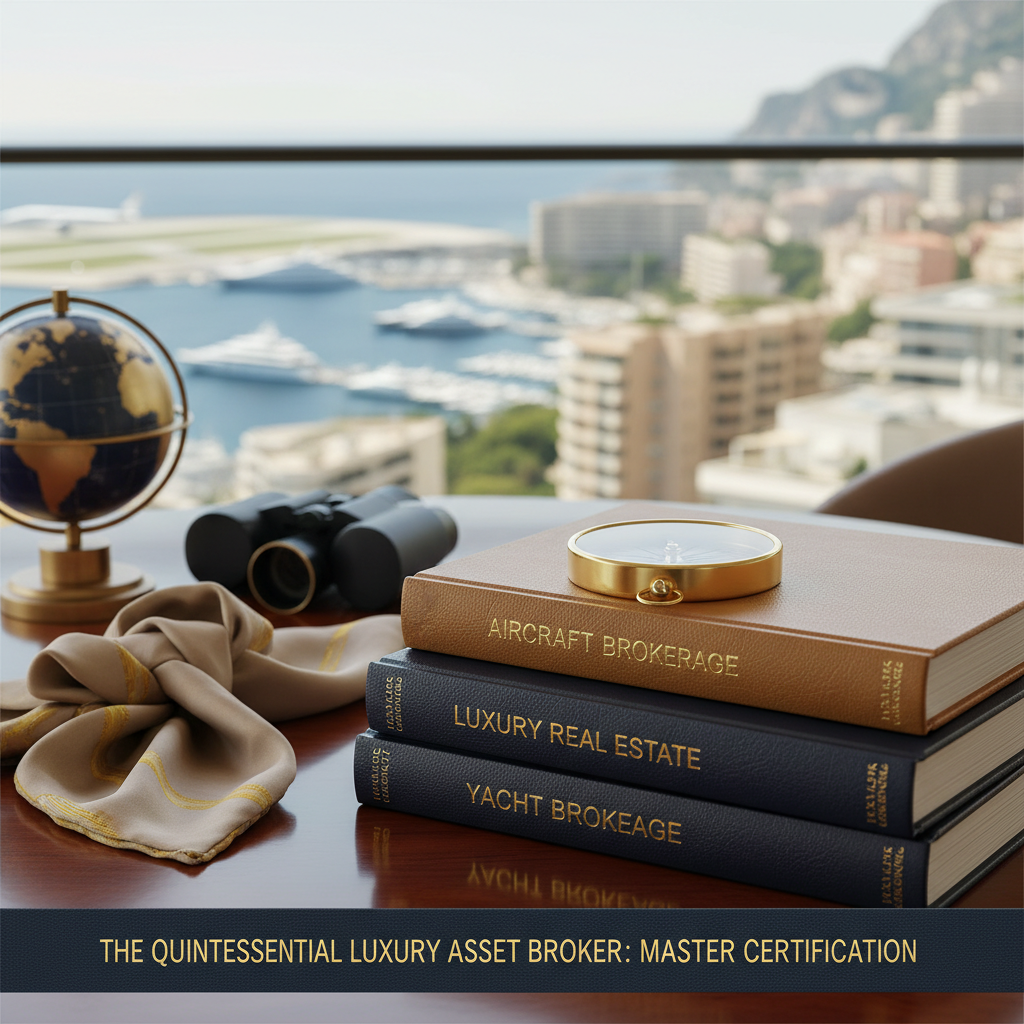
Recognising this market demand, forward-thinking professionals are completing The Quintessential Luxury Asset Broker: Master Certification. This flagship credential unites the traditionally separated fields of prime residential property, corporate aviation, and superyacht brokerage into a comprehensive executive framework. As recent market transactions reveal, advisors possessing this holistic toolkit achieve substantially higher deal flow and foster permanent client retention, displacing single-vertical brokers who lack systemic breadth.
The Four-Tier Transaction Methodology for Elite Brokers
Navigating multi-million-euro transactions across varied asset classes necessitates an immutable operational blueprint. Over the past month, leading advisors have codified this execution framework:
- Holistic Due Diligence: Investigating ownership histories, lien registries, and operational logs across maritime, aviation, and land registries before drafting formal letters of intent.
- Jurisdictional Harmonisation: Designing transaction conduits that maximize fiscal neutrality and ensure seamless cross-border regulatory compliance across European and international waters.
- Confidential Asset Marketing: Deploying private off-market placement protocols that protect principal privacy while activating qualified private-wealth buyer networks.
- Post-Closing Operational Integration: Ensuring seamless transition from acquisition to asset management, integrating dedicated crewing, management teams, and charter or lease revenue programs.
The Monaco Advantage: Why Location Dictates Global Standards
The geopolitical stability, advanced infrastructure, and unmatched density of private wealth within the Principality make it an unparalleled observatory for analyzing luxury market evolution. Understanding Why Monaco remains the definitive nexus for luxury business education requires appreciating its unique institutional fabric. Here, government policy, financial enterprise, and high-end lifestyle businesses interact in close physical and strategic proximity, creating an ecosystem that demands excellence across every profession.
The events of the past thirty days have confirmed that standards formulated in Monaco rapidly proliferate across global wealth epicentres from Dubai to Singapore, Miami, and Geneva. Whether through the implementation of maritime sustainability charters or the establishment of rigorous family office standards, Monaco does not merely mirror luxury trends—it defines them. Professionals trained within this ecosystem carry a stamp of operational legitimacy that is globally recognized and revered.
As market structures mature, the line separating transactional operators from authentic luxury advisors continues to widen. The findings gathered across recent weeks illustrate that the luxury marketplace belongs to credentialed, analytically rigorous, and ethically grounded professionals. By cultivating continuous executive learning and mastering high-yield operational frameworks, visionary practitioners are not merely weathering industry transformation—they are dictating its future direction.
Conclusion: The Strategic Imperative for Continuous Executive Development
The developments recorded over the past thirty days across our academic observatories reveal an inescapable reality: the global luxury economy is transitioning from an era of transactional opportunism to one of structured operational excellence. Whether stewarding private maritime fleets, safeguarding intergenerational family wealth, steering legacy fashion maisons, or brokering complex multi-asset deals, the demands placed upon industry leaders have never been more rigorous. Success in this evolving domain is exclusively reserved for professionals who combine profound strategic insight with accredited, domain-specific competence.
Monaco Academy continues to stand at the forefront of this educational movement, translating real-time luxury intelligence into actionable, world-class executive curricula. As the boundaries of the luxury industry expand and redefine themselves, ambitious practitioners must ask themselves whether their current capabilities match the elevated expectations of tomorrow's ultra-wealthy clientele. The past 30 days have demonstrated unequivocally that the pursuit of professional perfection is not merely an aspirational ideal; it is the ultimate competitive advantage in the modern luxury landscape.
Tagged
Written by
Monaco Academy Editorial
Editorial Team
Put this into practice
Courses and programs on this subject

Family Office Management Course
Become a Certified Family Office Manager leading ultra-high-net-worth families with bespoke financial, legal, and lifestyle solutions.

Wealth & Investment Management Course
Become a Certified Wealth & Investment Manager, mastering advanced strategies to navigate global financial markets and serve discerning clientele.

Yacht Brokerage Course
Become a Certified Yacht Broker. Navigate high-stakes yacht transactions and build a sterling reputation as a trusted advisor in the elite superyacht industry.
Related programs
Continue reading
Related articles

25 October 2026 · 11 min
Luxury Industries News and Insights — deep-dive explainer with practical takeaways
In an era defined by macroeconomic rebalancing, geopolitical friction, and shifting capital flows, staying abreast of luxury industries news and insights is no longer merely an exercise in commercial awareness; it is a fundamental strategic discipline. Acro…
24 October 2026 · 11 min
Monaco News and Insights — trend analysis with concrete examples
The Principality of Monaco continues to occupy an exceptional position in the global macroeconomic landscape, functioning not merely as a sovereign sanctuary for ultra-high-net-worth individuals (UHNWIs) but as an agile laboratory for the future of luxury c…
20 October 2026 · 12 min
Monaco News and Insights — deep-dive explainer with practical takeaways
In an era characterised by swift regulatory realignments, macroeconomic turbulence, and shifting global wealth corridors, tracking Monaco news and insights is no longer merely an exercise in following elite society or sovereign prestige. For family office p…