
Success Stories — trend analysis with concrete examples
The contemporary definition of triumph within the ultra-high-net-worth individual (UHNWI) sector has undergone a profound structural metamorphosis. Where previous market cycles celebrated sheer commercial volume and aggressive brand visibility, modern luxur…

The contemporary definition of triumph within the ultra-high-net-worth individual (UHNWI) sector has undergone a profound structural metamorphosis. Where previous market cycles celebrated sheer commercial volume and aggressive brand visibility, modern luxury success stories are increasingly forged within the discreet corridors of bespoke advisory, multi-asset syndication, and sovereign-grade wealth governance. The modern luxury professional does not merely sell products or facilitate isolated transactions; they navigate intricate geopolitical, financial, and regulatory currents to deliver seamless lifestyle ecosystems for global principals. To evaluate this operational paradigm requires a rigorous trend analysis underpinned by concrete case studies from the world’s most demanding capital hubs.
Today’s high-achieving advisors, family office directors, and luxury entrepreneurs operate at the intersection of tangible asset classes and intangible value propositions. The convergence of ultra-prime property acquisitions, superyacht charters, private aviation logistics, and alternative investments has rendered traditional sector silos obsolete. Those who command the market today are multi-disciplinary orchestrators capable of harmonising legal complexity, tax optimisation, and emotional resonance. Examining the anatomy of these modern triumphs reveals the definitive methodologies that separate routine service providers from indispensable trusted advisors.
The Structural Convergence of Passion Assets and Liquid Portfolios
A decade ago, the acquisitions of maritime vessels, private aircraft, and trophy estates were treated by wealth managers as tangential indulgences—cost centres to be audited rather than strategic pillars of a client's overarching holding structure. However, our ongoing analysis of cross-asset market intelligence demonstrates a decisive strategic pivot. High-value acquisitions are now meticulously engineered as multi-tiered portfolio components that deliver sovereign mobility, lifestyle security, and tangible capital preservation during periods of macroeconomic volatility.
This structural convergence is driven by the emergence of the global nomad class: principals whose business footprints, personal residences, and physical assets span multiple legal jurisdictions. When a transaction takes place, it rarely involves a single asset in isolation. Instead, an acquisition in the prime residential market of Monaco or the Cap d'Antibes frequently triggers secondary requirements involving maritime berths, private aviation positioning, and fiscal repositioning. Advisors capable of addressing this holistic reality are capturing unprecedented market share, establishing advisory retainers that transcend individual transaction cycles.
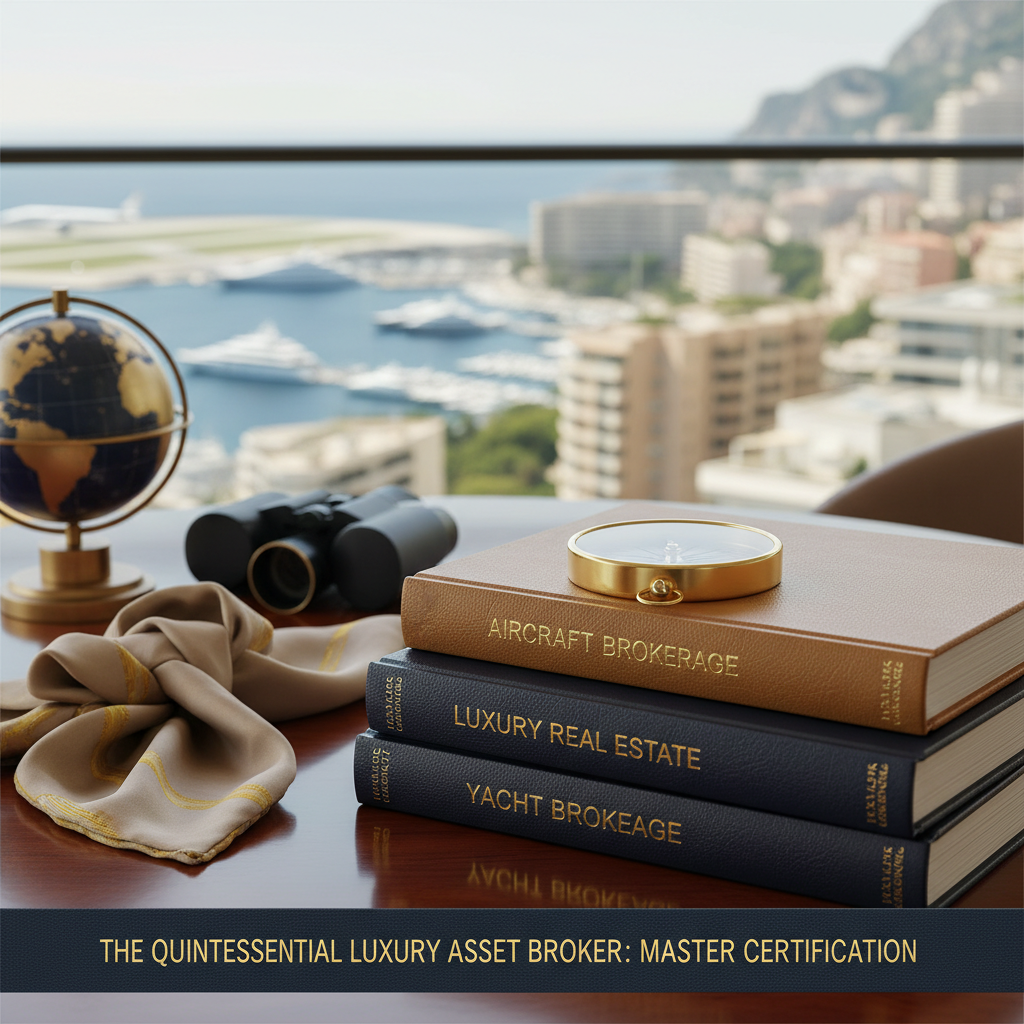
Professionals who possess foundational mastery across diverse verticals have established a distinct competitive moat. By undertaking comprehensive training such as The Quintessential Luxury Asset Broker: Master Certification, advisors develop the analytical dexterity required to speak the unified language of family offices, institutional private bankers, and maritime lawyers simultaneously. This educational groundwork underpins the most resilient success stories documented across the luxury landscape today.
Trend 1: Multi-Asset Advisory as the Primary Revenue Engine
The traditional broker or sales consultant is rapidly becoming disintermediated by direct digital access and commoditised listing platforms. The professionals achieving exponential revenue growth are those who have abandoned the mono-asset model in favour of multi-asset advisory ecosystems. The logic is compelling: UHNW clients value time efficiency and operational privacy above all else. Engaging three distinct, disconnected intermediaries to manage an estate purchase in Roquebrune-Cap-Martin, the chartering of a 60-metre expedition yacht, and the acquisition of an ultra-long-range jet introduces friction, leaks confidentiality, and elevates transactional overhead.
By contrast, modern advisory practices act as coordinated asset management boutiques. They review the macro positioning of the client's tangible holdings, identifying cross-asset efficiencies that conventional brokers overlook. For instance, structuring an aircraft lease-back programme to offset the operating costs of a maritime vessel, or synchronising the legal acquisition of an offshore berth with the purchase of a seafront villa, represents the sophisticated counsel modern principals demand. This trend has established a new class of hyper-specialised advisory firms that consistently outperform legacy luxury brokerage houses in transaction value per client.
Case Study: The €180 Million Monaco-Ligurian Marine-Residential Syndicate
To grasp the practical mechanics of modern luxury dealmaking, one must examine a landmark transaction orchestrated by an elite Mediterranean advisory consortium in late 2024. The client, a tech entrepreneur who had recently liquidated an enterprise software conglomerate, required an immediate relocation to the Côte d'Azur alongside the acquisition of both a permanent residence and a sustainable, commercially viable maritime platform.
The assignment presented multiple severe operational bottlenecks. The European residential market, particularly in the micro-territories of Monaco and surrounding prime enclaves, faced acute scarcity of newly renovated, turnkey penthouses possessing adequate structural volume for multi-generational living. Simultaneously, berthing allocations along the Riviera for yachts exceeding 65 metres were essentially non-existent for non-resident vessels without pre-existing commercial concessions.
"Discretion and multi-jurisdictional competency have replaced ostentation as the quintessential markers of elite advisory success. The modern transaction is won not on the showroom floor, but in the structural alignment of fiscal, operational, and physical architecture."
Rather than treating the property search and maritime search as independent workflows, the advisory team synthesised the requirements into a unified asset portfolio acquisition. Leveraging relationships honed through the Luxury Real Estate Brokerage Course, the lead advisor identified an off-market penthouse undergoing structural renovation in Monaco's Larvotto district, negotiating an option agreement tied directly to the successful acquisition of a 72-metre hybrid motor yacht under construction in a northern Italian shipyard.
The breakthrough occurred through the strategic acquisition of a long-term berth concession in a newly refurbished private marina near the Italian border, securing sovereign docking privileges while keeping operating expenditures tax-neutral via an active charter ownership framework. By orchestrating the real estate conveyance, maritime build-supervision, and yacht charter marketing concurrently, the advisory team concluded a complex €180 million multi-asset assignment within seven months. The transaction established a blueprint for modern cross-vertical execution, generating seven-figure advisory commissions across what legacy operators would have treated as disparate, uncoordinated market sectors.
Trend 2: The Professionalisation of Sovereign Mobility Infrastructure
The escalating unpredictability of global fiscal frameworks and geopolitical alignments has transformed physical mobility into an absolute priority for wealth creators. Private aviation and deep-sea maritime transport are no longer evaluated merely through the prism of convenience or indulgence; they are viewed as sovereign mobility assets designed to guarantee uninhibited movement across international boundaries during times of regulatory transition or systemic disruption.
Consequently, the operational standards demanded of asset managers have risen dramatically. Ultra-high-net-worth clients expect private aviation fleets to operate with the fiscal precision and safety compliance of boutique airlines, while demanding complete bespoke personalization. The operational managers who succeed in this space must balance strict airworthiness regulations, carbon-offset mandates, and complex international crew management frameworks.
This operational reality has generated immense demand for certified expertise in aviation logistics. Individuals completing specialized curricula such as the Private Jet Fleet Manager Course are capturing key executive roles within single-family offices and boutique management companies, replacing legacy operations personnel who often lack the formal commercial acumen required to manage multimillion-euro flight-hour budgets efficiently.
Key Drivers Behind the Rise of Managed Aviation Assets
Modern luxury advisory firms cite several primary catalysts driving the institutionalisation of private aircraft management:
- Regulatory Harmonisation and Taxation Clarity: Increasing scrutiny from international aviation authorities and regional tax bodies demands granular compliance reporting, eliminating the viability of amateur management structures.
- Asset Depreciation Mitigation: Precision lifecycle maintenance and sophisticated dry/wet lease arrangements preserve residual aircraft equity in fluctuating secondary markets.
- Carbon Accounting and Sustainable Aviation Fuel (SAF): HNWI principals increasingly require verified carbon reduction frameworks to preserve reputational standing and comply with local environmental decrees.
- Multi-Mission Fleet Deployment: Cross-utilising private jets for rapid executive business travel and multi-family leisure transport requires dynamic scheduling and operational resilience.
The Strategic Transformation of Modern Family Offices
Behind almost every major luxury transaction lies the administrative engine of the modern Family Office. As wealth consolidation accelerates, these private organisations have moved away from passive wealth management toward active, operational directorship of lifestyle portfolios, direct private equity investments, and legacy preservation initiatives. The chief operating officers of these institutions do not merely assess risk; they direct holistic asset integration.
This institutional maturity has permanently altered the commercial dialogue between luxury providers and private capital. Family offices demand quantifiable value propositions, transparent fee structures, and demonstrable due diligence protocols before approving high-value transactions. Advisors who rely solely on charisma or legacy social networks find themselves consistently outmanoeuvred by rigorous, institutionally trained professionals who approach luxury assets through the rigorous lens of wealth preservation and risk governance.
To engage credibly with this sophisticated demographic, practitioners must cultivate deep fluency in family office operations. Graduating from targeted programmes like the Family Office Management Course equips luxury professionals with the strategic vocabulary, governance principles, and fiduciary methodologies necessary to act as trusted extensions of the family office leadership team, as detailed in our analysis of multi-asset dealmaking architecture.
Case Study: Repositioning a Distressed 55-Metre Superyacht into an Income-Yielding Asset
Consider the trajectory of a distressed maritime asset managed by a private wealth advisor in 2023. A 55-metre tri-deck motor yacht, constructed in 2014 by a pedigree northern European shipyard, had suffered from years of deferred maintenance and poor commercial charter representation. Operating at an annual cash-drain deficit of €2.8 million for its owner—a Latin American industrial family—the vessel represented an untenable operational liability.
A newly appointed asset manager, possessing specialised training from our Yacht Brokerage Course, conducted an exhaustive physical, fiscal, and commercial audit of the vessel. The diagnostic revealed that while the hull and machinery remained mechanically flawless, the interior layout, crew service protocols, and digital charter narrative were out of step with post-pandemic charter expectations, which heavily prioritise wellness facilities, multi-generational entertainment systems, and hyper-reliable satellite connectivity.
- Comprehensive Financial and Engineering Audit: The asset manager paused all commercial activity for 90 days, bringing the vessel into an Italian refit yard to conduct critical engineering overhauls while stripping away redundant operating costs.
- Interior Reconfiguration and Aesthetic Repositioning: Capitalising on contemporary charter demand, the vessel’s formal dining room was converted into an onboard wellness suite, while the sundeck was re-engineered to feature a glass-fronted Jacuzzi and custom exterior bar.
- Crew Culture and Operational Re-Alignment: The operational team replaced passive crew hiring practices with elite hospitality talent, establishing service benchmarks borrowed directly from five-star boutique hotels.
- Strategic Brand Relaunch and Targeted Charter Distribution: Rather than listing the yacht across generalised platforms, the manager forged exclusive distribution relationships with top-tier global charter brokers, positioning the vessel as the premier wellness-focused charter platform for the Mediterranean summer and Caribbean winter seasons.
The outcome was an operational turnaround of significant magnitude. Within eighteen months of re-entering service, the vessel achieved 14 fully booked charter weeks per annum, transforming a €2.8 million annual operational deficit into a net operating surplus of €420,000, while elevating the underlying market valuation of the yacht by an estimated €6.5 million. This concrete success story underscores a fundamental luxury reality: value is not an intrinsic constant; it is an active variable created through superior strategic management and operational foresight.
Monaco as the Global Benchmark for Advisory Excellence
The strategic shifts detailed throughout this analysis do not occur in a vacuum; they converge within specific micro-ecosystems possessing the regulatory sophistication and concentration of capital required to foster them. The Principality of Monaco remains the undisputed global laboratory for these next-generation luxury paradigms. Operating at the centre of international maritime brokerage, private banking, and trophy real estate, Monaco serves as both the proving ground and the standard-bearer for elite commercial execution.
The unique regulatory and physical geography of the Principality necessitates an exceptional level of professional competence. With land at an unparalleled premium and the waters of Port Hercule and Port de Fontvieille commanding the highest berth values on earth, there is no margin for amateurism. The advisors who thrive in this environment maintain exacting standards of confidentiality, technical acumen, and cross-cultural adaptability. To discover more regarding the unique fiscal and commercial architecture that makes this territory the world capital of high-value dealmaking, explore Why Monaco represents the ultimate epicentre for luxury education and enterprise.
At About Monaco Academy, our academic mission is inextricably linked with these monégasque principles of operational discipline, discreet professionalism, and multi-asset mastery. By synthesizing real-world case studies from the Principality’s most influential transactions into actionable executive curricula, we prepare the next generation of global advisors to lead where traditional approaches falter.
Strategic Framework: Deconstructing the Modern Luxury Triumph
When distilling the operational lessons from the past decade of luxury industry success stories, several common denominators emerge. High performers across luxury real estate, yacht brokerage, private aviation, and wealth structuring adhere to a consistent operational framework that mitigates risk while compounding client enterprise value.
| Operational Dimension | Legacy Luxury Brokerage | Next-Gen Strategic Advisory |
|---|---|---|
| Core Commercial Value | Product access & transactional speed | Cross-asset strategy & holistic governance |
| Client Engagement Model | Ephemeral, transaction-dependent | Multi-year retainer & portfolio oversight |
| Operational Focus | Public marketing & listing platforms | Off-market intelligence & private syndication |
| Technological Integration | Basic CRM & social media distribution | Encrypted communications & institutional asset audits |
This structural divergence demonstrates why legacy intermediaries are facing margin compression, while cross-certified advisors are securing unprecedented fee structures. The modern principal does not pay for access; they pay for clarity, risk elimination, and the flawless execution of complex, multi-jurisdictional objectives.
Future-Proofing the Luxury Career: The Imperative for Continuous Specialisation
As the velocity of capital increases and the regulatory landscape governing wealth transparency continues to tighten, the barrier to entry for top-tier luxury advisory will continue to rise. Amateurs reliant on informal networks are finding their traditional playbooks obsolete. The professionals authoring tomorrow’s success stories are systematically re-engineering their skill sets to meet the analytical demands of an increasingly sophisticated client base.
Achieving distinction in this elevated arena requires an uncompromising commitment to ongoing professional development. Whether mastering the nuances of international maritime law, deconstructing the capital requirements of ultra-prime developments, or learning to operate fluidly within the governance frameworks of single-family offices, structured education provides the foundational bedrock upon which lasting careers are constructed. The future of luxury does not belong to those who merely admire the lifestyle; it belongs to the strategists who build its operational infrastructure.
Tagged
Written by
Monaco Academy Editorial
Editorial Team
Put this into practice
Courses and programs on this subject

Yacht Brokerage Course
Become a Certified Yacht Broker. Navigate high-stakes yacht transactions and build a sterling reputation as a trusted advisor in the elite superyacht industry.

Family Office Management Course
Become a Certified Family Office Manager leading ultra-high-net-worth families with bespoke financial, legal, and lifestyle solutions.

Luxury Influencer Business Course
Become a Certified Luxury Influencer Entrepreneur, mastering brand partnerships, content creation, and monetization in the high-end market.
Related programs
Continue reading
Related articles

14 November 2026 · 10 min
Press Releases — newsworthy angle relevant to luxury professionals
In an era characterised by immediate algorithmic dissemination and heightened capital scrutiny, the corporate press release within the luxury sphere has undergone an existential metamorphosis. Far from being a mere informational dispatch or promotional exer…
10 November 2026 · 10 min
Monaco Academy News and Insights: The Strategic Rise of Cross-Asset Luxury Advisory
Monaco Academy's latest intelligence report highlights a decisive shift among elite family offices toward multi-asset advisory competencies spanning superyachts, private aviation, and bespoke governance.
01 November 2026 · 10 min
Monaco News and Insights — deep-dive explainer with practical takeaways
In an era punctuated by geopolitical realignments, shifting fiscal treaties, and the relentless modernisation of transnational wealth, the Principality of Monaco continues to occupy an incomparable vantage point. As global sovereign capital seeks both regul…